
Federal Reserve holds interest rates steady
(NEW YORK) -- The Federal Reserve held interest rates steady on Wednesday, ending a string of three consecutive quarter-point rate cuts as the central bank grapples with a combination of elevated inflation and sluggish hiring.
The move marked the first interest-rate decision since news surfaced earlier this month of a federal criminal investigation into Fed Chair Jerome Powell.
The choice to maintain interest rates at their current level echoed a cautious approach outlined by Powell last month, before reports of the investigation into his conduct.
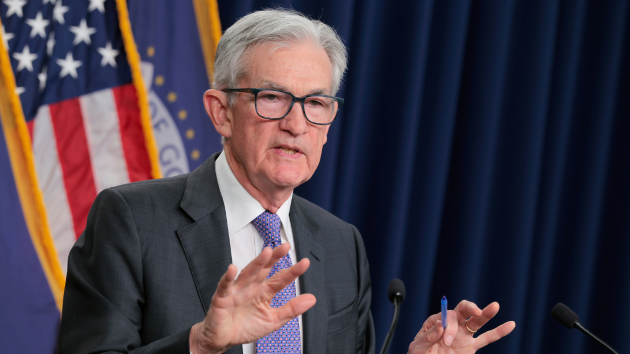
"We see the current stance of monetary policy as appropriate to encourage progress toward both our maximum employment and 2% inflation goals," Powell said at a press conference in Washington, D.C., on Wednesday.
He appeared to view the economy in a favorable light, saying it is expanding at a "solid pace."
"While job gains have remained low, the unemployment rate has shown some signs of stabilization," Powell added.
The unemployment rate dropped to 4.4% in December from 4.6% in November, the Bureau of Labor Statistics said earlier this month. Unemployment remains low by historical standards but had ticked up from previous lows.
The benchmark rate stands at a level between 3.5% and 3.75%. That figure marks a significant drop from a recent peak attained in 2023, but borrowing costs remain well above a 0% rate established at the outset of the COVID-19 pandemic.
Futures markets expect two quarter-point interest rate cuts this year, forecasting the first in June and a second in the fall, according to CME FedWatch Tool, a measure of market sentiment.
The investigation into Powell ratcheted up an extraordinary clash between the nation's top central banker and the White House, which has urged the Fed to significantly reduce interest rates.
The federal probe appears to center on Powell's testimony to Congress last year about cost overruns in a multi-billion-dollar office renovation project. Powell, who was appointed by Trump in 2017, issued a rare video message earlier this month rebuking the investigation as a politically motivated effort to influence the Fed's interest rate policy.
The investigation follows months of strident criticism leveled at the Fed by Trump. The president denied any involvement in the criminal investigation during a brief interview with NBC News hours after the Fed posted Powell's video.
Over the past year, hiring has slowed dramatically while inflation has remained elevated, risking an economic double-whammy known as "stagflation." Those conditions have put the Fed in a difficult position.
The central bank must balance a dual mandate to keep inflation under control and maximize employment. To address pressure on both of its goals, the Fed primarily holds a single tool: interest rates.
The strain on both sides of the Fed's mandate presents a "challenging situation" for the central bank, Powell noted last month.
"There's no risk-free path for policy as we navigate this tension between our employment and inflation goals," Powell said.
If the Fed raises interest rates as a means of protecting against elevated inflation, it risks a deeper slowdown of the labor market. On the other hand, by lowering rates to stimulate hiring, the Fed threatens to boost spending and worsen inflation.
The criminal investigation into Powell raised concern among some analysts and former top Fed officials, who said it poses a threat to central bank independence.
In the event a central bank loses independence, policymakers tend to favor lower interest rates as a means of boosting short-term economic activity, analysts previously told ABC News. Such a posture could pose a major risk of yearslong inflation fueled by a rise in consumer demand, untethered by interest rates.
On Wednesday, Powell declined to comment on the criminal investigation into his conduct. Minutes later, he reaffirmed his support for the political independence of the central bank.
"We haven’t lost it [and] I don't believe we will," Powell told ABC News' Elizabeth Schulze. "I'm strongly committed to that and so are my colleagues."
Federal law allows the president to remove the Fed chair for "cause" -- though no precedent exists for such an ouster. Powell's term as chair is set to expire in May, but he can remain on the Fed's policymaking board until 2028. On Wednesday, he declined to comment on his plans.
ABC News' Elizabeth Schulze contributed to this report.
Editor's note: This story has been updated.
Copyright © 2026, ABC Audio. All rights reserved.



Catch local and national news 24/7 from Fox News and NH1