
Newsom, AOC seek to boost profiles, reassure allies at Munich Security Conference
(WASHINGTON) -- While it's not Des Moines or Manchester, Munich may be on some Democrats' path to a White House run or higher office.
Several Democrats thought to be considering 2028 presidential runs are attending the Munich Security Conference in Germany this weekend to boost their profiles and strengthen bonds with European allies strained in the first year of President Donald Trump's second term.
From Gov. Gavin Newsom of California to Sen. Ruben Gallego, D-Ariz., and Rep. Alexandria Ocasio-Cortez, D-N.Y., the Democrats plan to push an alternative to Trump's aggressive and transactional foreign policy agenda, lawmakers, aides and analysts told ABC News.
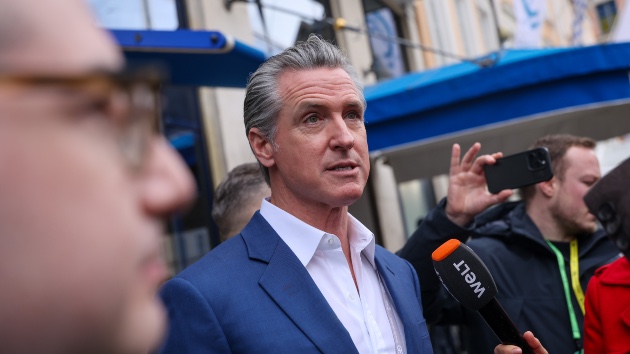
Newsom is expected to address the conference, meet with German Chancellor Friedrich Merz and formalize a new partnership between California and Ukraine.
In a post on X, Gallego previewed his visit, writing: "I'm headed to the Munich Security Conference this weekend to talk about rebuilding alliances and restoring steady American leadership. To meet the threat of China, the world needs a partner it can count on again, not chaos."
At last year's gathering, Vice President JD Vance criticized European allies, accusing them of censoring right-wing political parties and not doing more to stop illegal migration.
Since then, Trump's on-again, off-again tariffs, repeated threats to seize Greenland and calls for NATO allies to spend more on security have forced longtime U.S. allies to question American commitments.
Trump has also more readily deployed the U.S. military abroad in his second term, striking three Iranian nuclear sites last June, and attacking Venezuela to capture its leader, Nicolas Maduro, in January.
"We know the old order is not coming back. We shouldn't mourn it," Canadian Prime Minister Mark Carney said in a speech in Davos, Switzerland, last month. "Middle powers must act together because if we're not at the table, we're on the menu."
Democrats will have to reaffirm their support for strong transatlantic ties while navigating European skepticism after Trump's 2024 victory, Damian Murphy, a former Democratic foreign policy staffer and senior vice president of National Security at the Center for American Progress, told ABC News.
"They have to be careful not to overpromise and send too much of a message of reassurance, because at the end of the day, Trump is still in the White House and still directs foreign policy," he said. "But it's important for a European audience to understand that that's not a monolithic view."
The conference is also an opportunity for Democrats to bring new perspectives to the world stage and give them an opportunity to "establish relationships" with world leaders, Murphy added.
Ocasio-Cortez, who is one of the most prominent progressive voices in the party, is running for reelection in 2026 and has not said whether she plans to run for Senate or the White House in 2028, though supporters have encouraged her to do so.
The New York Democrat, who does not serve on any national security committees in Congress like most lawmakers traveling to Munich, will participate in two panels on Friday, as she takes a bigger step onto the foreign policy stage.
Matt Duss, a former adviser to Sen. Bernie Sanders, I-Vt., who has advised Ocasio-Cortez on foreign policy, told ABC News he expects her to share a progressive perspective on foreign policy, one intertwined with her domestic politics aimed at combating economic inequality and improving the conditions for working people.
"I think it's safe to say that the American electorate has some very serious questions and different ideas about how the U.S. should act in the world than it has previously," Duss told ABC News.
Ocasio-Cortez has also been a critic of Israel's war in Gaza against Hamas and accused Israel of genocide against the Palestinian people. She also voted against an amendment that would have stripped U.S. funding for Israel's missile defense systems, but has pushed back against U.S. offensive military aid to Israel.
Secretary of State Marco Rubio, who is leading the Trump administration's delegation to Munich, called the summit "an important conference" and that other delegations "want honesty" and "want to know where we're going, where we'd like to go with them."
"We live in a new era in geopolitics, and it's going to require all of us to sort of reexamine what that looks like and what our role is going to be," he said.
ABC News' Isabella Murray contributed to this report
Copyright © 2026, ABC Audio. All rights reserved.



Catch local and national news 24/7 from Fox News and NH1