
US official says progress made in talks with Iran, US-Ukraine Russia meetings to continue
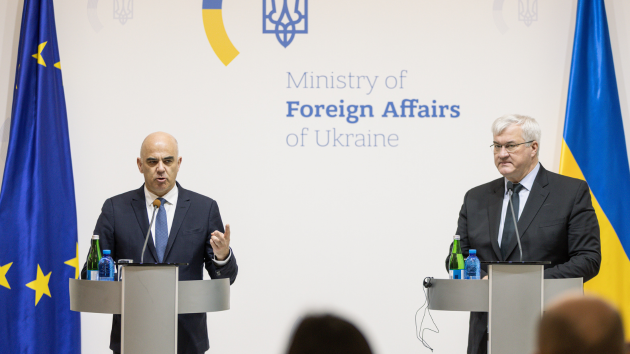
LONDON -- After talks in Geneva on Tuesday between the U.S. and Iran over the latter's nuclear energy program and trilateral talks between Russia, Ukraine and the U.S. over Russia's invasion of Ukraine, Iranian officials expressed optimism for a deal while US-Russia-Ukraine discussions are expected to resume on Wednesday.
Following the talks with Iran, a U.S. official said that "progress was made, but there are still a lot of details to discuss."
The U.S. official said that the Iranians said they will "come back in the next two weeks with detailed proposals to address some of the open gaps in our positions."
But U.S. Vice President JD Vance in an interview with Fox News on Tuesday said the Iranians aren’t acknowledging some “red lines” that U.S. President Donald Trump has set.
"In some ways it went well, they agreed to meet afterwards, but in other ways it was very clear that the president has set some red lines that the Iranians are not yet willing to actually acknowledge and work through.” Vance said. “So, we're going to keep on working it. But of course, the president reserves the ability to say when he thinks that diplomacy has reached its natural end. We hope we don't get to that point, but if we do, that will be the president's call.”
Iranian Foreign Minister Abbas Araqchi said a "window of opportunity," has opened with this second round of negotiations. Araqchi made the comments while giving a speech to the United Nations Conference on Disarmament after Tuesday's talks.
"We are hopeful that negotiation will lead to a sustainable and negotiated solution which can serve the interests of relevant parties and the broader region. At the same time, as demonstrated during the aggression of 13 June 2025, Iran remains fully prepared to defend itself against any threat or act of aggression," Araqchi said in English.
Araqchi also noted the "conduct" of the U.S. "has seriously undermined the credibility of the negotiating process," referring to the US withdrawal from the JCPOA during the first Trump administration.
"The unilateral withdrawal of the United States from the JCPOA [Joint Comprehensive Plan of Action], in clear violation of an internationally endorsed agreement, dealt a profound blow to trust and stability of multilateral obligations," Araqchi added.
Special envoy Steve Witkoff and Jared Kushner -- U.S. President Donald Trump's son-in-law -- also led American negotiators in Geneva in high-stakes talks on Tuesday regarding Russia's ongoing full-scale invasion of Ukraine, which lasted about six hours, Russian state media TASS reported.
Secretary of the National Security and Defense Council of Ukraine Rustem Umerov said the talks focused on "practical issues," and "the mechanics of possible solutions," in a post on Telegram Tuesday evening.
Both Russia and Ukraine confirmed talks will continue Wednesday.
The talks on Ukraine are in a trilateral format, which include American, Ukrainian and Russian representatives. They are the third installment of the trilateral format following two rounds of negotiations in the United Arab Emirates.
Those previous trilateral talks were described as constructive by participants but appeared to have failed to achieve a breakthrough on key contentious points, such as the fate of Ukraine's partially occupied eastern Donbas region, the future of the Russian-occupied Zaporizhzhia nuclear power plant and proposed Western security guarantees for Kyiv.
Asked what he expected ahead of the talks with Russia and Ukraine, Trump on Monday put the onus on Ukraine to "come to the table fast," appearing to suggest that the U.S. and Russia "are in a position" to make a deal.
"Well they're big talks. It's going to be very easy," Trump said. "Ukraine better come to the table fast. That's all I'm telling you. We are in a position; we want them to come."
Before the trilateral talks began Tuesday, Russia again heavily attacked Ukraine's energy infrastructure overnight with at least 396 drones and 29 missiles of various types, the Ukrainian Air Force said Tuesday morning.
"It was a combined strike, deliberately calculated to cause as much damage as possible to our energy sector," Zelenskyy wrote in a post on X.
In a statement after talks ended on Tuesday, Zelenskyy said negotiators must raise the continuing Russian strikes, especially with the Americans, who proposed that Ukraine and Russia refrain from attacks.
"Ukraine is ready. We do not need war. And we always act symmetrically -- we are defending our state and our independence. Likewise, we are ready to move quickly toward a just agreement to end the war," Zelenskyy said.
Zelenskyy said he was waiting on the Ukrainian delegation to report back to him.
Twelve regions of Ukraine were targeted in the Russian strikes and at least nine people, including children, were injured, the Ukrainian president said.
Among the targets was the southern port city of Odesa and the wider region, where "tens of thousands of people are without heat and water supply after the drone strike," according to Zelenskyy.
Poland's Armed Forces Operational Command said NATO aircraft were scrambled and air defenses put on alert as a response to the Russian strikes. "No violations of the Republic of Poland's airspace by objects that could pose a threat were recorded," the command said on X.
Russia's Defense Ministry, meanwhile, said its forces shot down at least 151 Ukrainian drones overnight.
Trump "indirectly" involved in Iran talks
Trump told reporters aboard Air Force One on Monday that he would be "indirectly" involved in Tuesday's talks with Iran.
"They'll be very important," Trump told reporters of the talks. "We'll see what can happen. Specifically, Iran is a very tough negotiator."
Trump has said the U.S. wants Iran to end all nuclear enrichment as part of any deal, while American officials have also indicated that the U.S. wants constraints on Tehran's ballistic missile program and its support of regional proxies.
All three demands have long been U.S. goals, but such proposals have been repeatedly rebuffed by Iranian leaders.
The talks have been preceded by a U.S. military buildup in the Middle East, with officials in Tehran warning that Iranian forces will retaliate against U.S. and Israeli targets if Iran is attacked.
The latest round of talks also come in the aftermath of a major anti-regime uprising in Iran, in which protests -- initially sparked by the deteriorating economic conditions inside the country -- spread nationwide. Trump offered his support to the demonstrators, telling them to "keep protesting," saying, "help is on its way."
Security forces violently suppressed the demonstrations, killing at least 7,000 people according to data published by the U.S.-based Human Rights Activists News Agency (HRANA).
ABC News' Anne Flaherty, Lalee Ibssa, Joseph Simonetti, Fidel Pavlenko, Natalia Popova and Morgan Winsor contributed to this report.
Copyright © 2026, ABC Audio. All rights reserved.



Catch local and national news 24/7 from Fox News and NH1