
As war with Iran stretches on, some experts raise concerns over ‘war of attrition’ with missile stockpiles
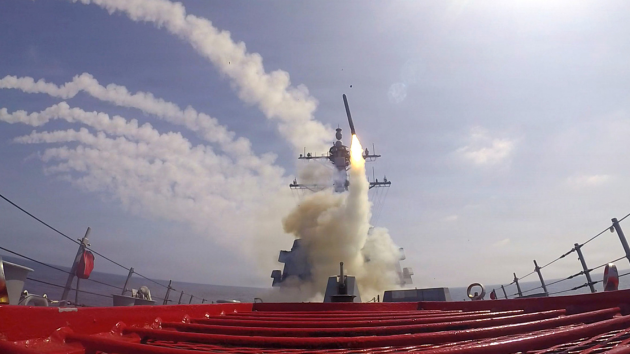
(NEW YORK) -- While President Donald Trump says Operation Epic Fury could last several weeks, a question some are raising is how long U.S. and allies' missile defense stockpiles can last in an extended conflict with Iran.
Trump has insisted that the U.S. is well equipped to fight, with a "virtually unlimited supply," and other Gulf states have pushed back on claims that they are running out of air defense missiles.
Responding to a questions Wednesday, Defense Secretary Pete Hegseth told reporters that the military's stockpiles of offensive and defensive missiles, including Patriot missies, was "extremely strong."
"The enemy can no longer shoot the volume of missiles they once did. Not even close," he told reporters.
Asked if Iran might be able to outlast the U.S. ability to intercept their missiles, Hegseth criticized speculation that the U.S. has stockpile limitations.
“Iran cannot outlast us, he said, adding, "The only limits we have in this is President Trump's desire to achieve specific effects on behalf of the American people."
"The enemy is is off balance, and we're going to keep them off balance. And we know their ability to shoot versus our ability to defend," he said. "That difference gets wider and wider every day. Our defense gets better."
Joint Chiefs Chairman Gen. Dan Caine added, “We have sufficient precision munitions for the task at hand, both on the offense and defense."
"I know there's been a great debate about that, and I appreciate the interest, but just know that we consider that an operational security matter," her said.
How much of the U.S. interceptor stockpile is being used up to defend against Iran's continued heavy missile and drone attacks, as Caine said, is classified, but it's expected to be among questions congressional lawmakers have for top Trump administration officials.
Some experts are also raising concerns about America's cache of the expensive air defense missiles as the Iranian military continues to target U.S. assets and other allies in retaliation.
Kelly Grieco, a senior fellow at the Stimson Center think tank and former assistant professor at the Air Command and Staff College, told ABC News that the conflict is becoming a "war of attrition."
Watch special coverage on Nightline, "War with Iran," each night on ABC and streaming on Disney+ and Hulu.
The U.S. and Israeli militaries are now in a race to intercept Iran's missile capabilities, including launchers and production facilities, before the U.S. and Israel's own stockpile of air defense interceptor missiles in the region is depleted, according to Grieco.
"The question is becoming who runs out of missiles first. Does the defender run out of interceptors," she asked, referring to the armies of the U.S., Israel and the Gulf states. "Or does Iran run out of missiles, or their ability to launch missiles?"
"If the Iranians are able to launch with the kinds of numbers they have been launching over the past 48 hours over the next four to five weeks, that does not seem sustainable from an interceptor perspective," she added.
"But if those numbers drop off because the U.S. and Israel destroy the launchers themselves, or their storage facilities, and the numbers drop dramatically, then we could potentially sustain this campaign," Greico said.
Retired Lt. Gen. Dan Karbler, former commander of the U.S. Space and Missile Defense Command, told ABC News Live Tuesday that extensive drone use by the Iranian military has prompted the use of smaller short-range missiles as interceptors.
"We don't want to shoot Patriot missiles at the drones," he said. "So, some of our short-range air defense, more capability of that type of nature needs to flow into countries so we're using our short-range missiles to take out these drones not our very limited patriot missiles."
President Trump attempted to assuage concerns about the stockpile Tuesday -- but also acknowledged the number of some of the highest-grade munitions is "not where we want it to be."
"The United States Munitions Stockpiles have, at the medium and upper medium grade, never been higher or better -- As was stated to me today, we have a virtually unlimited supply of these weapons," Trump wrote on social media early Tuesday morning.
And even as he says the U.S. will "easily prevail" in this war and that the U.S. is prepared for the operation to go on for "whatever it takes," Trump wrote that "Wars can be fought "forever," and very successfully, using just these supplies."
The U.S. was already concerned about its stockpile before this war as the Russian-Ukraine conflict, the Israeli-Gaza conflict and last summer's conflict with Iran have dramatically increased demand for Patriot and THAAD missiles, according to Greico.
Terminal High Altitude Area Defense missiles that are used to intercept Iran's most powerful ballistic missiles are in particularly short supply. Grieco estimated that if the U.S. uses its THAAD missiles at same rate as the 12-day conflict with Iran last year, it might only have enough for about two weeks.
Even if the U.S. had allocated half its total THAAD stockpile to that war last year-- something Grieco said was extraordinarily unlikely -- that would only have lasted five to six weeks. A quarter of the stockpile then would have been sufficient for just two weeks at most, she said.
"What percentage of the stockpile are they allocating to this war," Grieco said. "That’s the real question."
Interceptor missiles are expensive and are very time consuming to produce, meaning that the U.S. and its allies cannot quickly replenish them. They are also usually far more costly than the Iranian projectiles they are used to guard against.
The situation is even more complicated for the U.S. Gulf state allies, which cannot produce their own interceptors and are likely burning through them at a rapid rate, according to military analysts. The United Arab Emirates on Tuesday issued a statement vehemently denying reports it was running short of interceptors.
Iran has not launched missiles at the same scale so far compared to the attacks during conflict with Israel last year.
Israeli officials and independent experts said they believe that may reflect a strategy by Iran to run down air defense supplies with relatively smaller but steady attacks over a longer period. It was also possible U.S. and Israeli attacks were succeeding in severely degrading Iran's ability to launch.
ABC News' Ivan Pereira and Meghan Misty contributed to this report.
Copyright © 2026, ABC Audio. All rights reserved.



Catch local and national news 24/7 from Fox News and NH1