
US fighter jet shoots down Iranian drone approaching US aircraft carrier
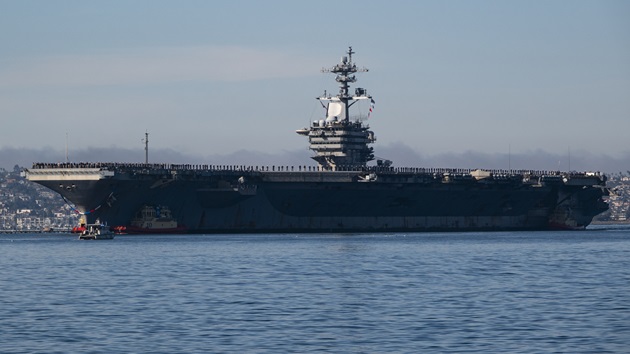
(WASHINGTON) -- A U.S. fighter jet shot down an Iranian drone as it approached the aircraft carrier USS Abraham Lincoln in the Arabian Sea on Tuesday, according to a statement from U.S. Central Command. Earlier in the day, a Navy destroyer came to the assistance of a U.S.-flagged tanker that was harassed by multiple Iranian small boats as it transited the Strait of Hormuz.
The drone was shot down by a Navy F-35C fighter jet from the carrier as it "aggressively approached" the Lincoln with "unclear intent," Central Command said.
Iran's Shahed drones are long-range, one-way attack drones capable of carrying more than 100 pounds of explosives. Russia has used large numbers of them to carry out destructive long-range attacks inside of Ukraine.
In a separate incident earlier Tuesday, a U.S. Navy destroyer and U.S. Air Force aircraft came to the assistance of a U.S.-flagged, U.S.-crewed tanker that was harassed by Iranian small boats and a drone as it transited through the Strait of Hormuz, according to Central Command (CENTCOM).
The Lincoln was in the Arabian Sea approximately 500 miles from Iran's southern coast when an Iranian Shahed-139 drone "unnecessarily maneuvered toward the ship," CENTCOM said in a statement.
"The Iranian drone continued to fly toward the ship despite de-escalatory measures taken by U.S. forces operating in international waters," the statement said.
The fighter jet shot down the drone "in self-defense and to protect the aircraft carrier and personnel on board," according to the statement, which said no service members were harmed and no U.S. equipment was damaged.
The Lincoln arrived in the Middle East last week and has been operating in the northern Arabian Sea along with three destroyers that make up its carrier strike group.
There are six other U.S. Navy ships in the Middle East: a destroyer in the Red Sea, two other destroyers near the Strait of Hormuz, and three littoral combat ships in the Persian Gulf.
One of those destroyers, the USS McFaul, was involved in the earlier incident to assist the M/V Sterna Imperative after it was approached at high speed by two Iranian Revolutionary Guard boats and a Mohajer drone, according to CENTCOM.
U.S. Central Command said the Iranian craft had "threatened to board and seize the tanker" as it transited through the Strait of Hormuz.
The McFaul was operating in the area "and immediately responded to the scene to escort M/V Stena Imperative with defensive air support from the U.S. Air Force," the statement said.
The situation "de-escalated as a result, and the U.S.-flagged tanker is proceeding safely," according to the statement.
Central Command warned that "continued Iranian harassment and threats in international waters and airspace will not be tolerated."
Last week CENTCOM issued a stern warning that it would defend U.S. assets in the region after Iran announced a two-day, live-fire naval exercise in the Strait of Hormuz that was set to begin last Sunday.
It urged Iran to carry it out it exercise in a safe and professional way to avoid unnecessary risks to maritime traffic.
"CENTCOM will ensure the safety of U.S. personnel, ships, and aircraft operating in the Middle East," it said in a statement issued Friday. "We will not tolerate unsafe IRGC actions including overflight of U.S. military vessels engaged in flight operations, low-altitude or armed overflight of U.S. military assets when intentions are unclear, highspeed boat approaches on a collision course with U.S. military vessels, or weapons trained at U.S. forces."
Copyright © 2026, ABC Audio. All rights reserved.



Catch local and national news 24/7 from Fox News and NH1