
Trump says US talking to ‘new’ and ‘more reasonable’ Iranian regime, Rubio declines to say who
(WASHINGTON) -- President Donald Trump on Monday said the U.S. is engaged in serious talks with a "new" and "more reasonable" regime in Iran as the war enters its fifth week.
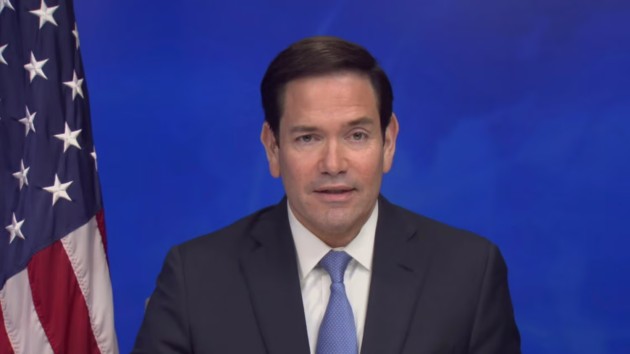
Secretary of State Marco Rubio, during an appearance on "Good Morning America," declined to say who exactly the U.S. is negotiating with.
"Well, I'm not going to disclose to you who those people are, because it probably would get them in trouble with some other groups of people inside of Iran. Look, there's some fractures going on there internally," Rubio said.
"And if there are new people now in charge who have a more reasonable vision of the future, that would be good news for us, for them, for the entire world," the secretary continued. "But we also have to be prepared for the possibility, maybe even the probability, that that is not the case."
When pushed for more clarity, Rubio said, "You have people there that are saying some of the right things privately."
"But at the end of the day, we have to see if these people end up being the ones in charge, seeing if they're the ones that have the power to deliver. We're going to test it. We are hopeful that’s the case,” he went on. "There are clearly people there talking to us in ways that previous people in charge in Iran have not spoken to us in the past."
White House press secretary Karoline Leavitt, at a briefing on Monday, also denied to identify the "new" leadership in Iran mentioned by the president, but insisted talks are ongoing.
"When the president says 'more reasonable,' again, these folks are appearing more reasonable behind the scenes privately in these conversations than perhaps some of the previous leaders who are now no longer on planet Earth because they lied to the United States, and they strung us along in negotiations," she told reporters. "And that was unacceptable to the president, which is why many of the previous leaders were killed."
Iranian officials have denied any direct talks with the U.S., saying that messages have been passed through intermediaries. Esmaeil Baqaei, spokesman for Iran's Foreign Ministry, said Monday, "We have not had any negotiations with America."
The U.S. presented Iran with a 15-point framework for a peace deal by way of Pakistan last week. Baqaei commented on the U.S. proposal during a press conference Monday.
"The information that has been conveyed to us [from the US], regardless of what name you want to give it, as 15 articles or whatever you call it, involved a large number of requests that are excessive, unrealistic, and illogical," Baqaei said.
Pakistan's Foreign Minister Ishaq Dar said on Sunday that the country would host talks between the U.S. and Iran "in the coming days." There has not been confirmation from either Iran or the U.S. on when exactly these talks would take place or who will be involved for either side.
Trump on Sunday told reporters he could "see a deal" being made with Iran soon, though "it's possible we won't."
The president suggested talks were moving in a positive direction because Iran allowed 20 oil tankers to pass through the critical Strait of Hormuz, which Iran has effectively blocked to international shipping traffic after the U.S. and Israel launched attacks on the country last month.
Trump on Monday continued to tout progress but also threatened major U.S. attacks on Tehran's energy infrastructure and more if a diplomatic off-ramp isn't reached.
"The United States of America is in serious discussions with A NEW, AND MORE REASONABLE, REGIME to end our Military Operations in Iran," he wrote in a post to his social media platform.
"Great progress has been made but, if for any reason a deal is not shortly reached, which it probably will be, and if the Hormuz Strait is not immediately 'Open for Business,' we will conclude our lovely 'stay' in Iran by blowing up and completely obliterating all of their Electric Generating Plants, Oil Wells and Kharg Island (and possibly all desalinization plants!), which we have purposefully not yet 'touched,'" the president posted.
Last week, Trump extended the deadline for Iran to reopen the strait twice. Trump said the U.S. would continue a pause on energy site attacks until next Monday, April 6.
Trump has not ruled out using ground troops in Iran. Experts say troops could be used to seize Iran's nuclear material or Kharg Island, the country's primary oil export hub.
"I just have lots of alternatives," Trump said on Sunday.
More U.S. service members have arrived in the Middle East, including roughly 3,500 sailors and Marines with the 31st Marine Expeditionary Unit.
Trump told the Financial Times on Sunday that he wants the U.S. to "take the oil in Iran."
"Maybe we take Kharg Island, maybe we don’t. We have a lot of options,” Trump told the news outlet.
ABC's George Stephanopoulos pressed Rubio on Monday about how the president would go about taking Kharg Island and whether it would require American troops on the ground.
Rubio was noncommittal, but said again that Iran's threats about controlling the Strait of Hormuz in perpetuity needed to be addressed.
"That's not going to be allowed to happen. And the president has a number of options available to him, if he so chooses, to prevent that from happening," Rubio said.
"There is a way forward here. We are going to achieve our objectives in a matter of weeks, not months," Rubio added.
Leavitt on Monday reiterated the administration's four-to-six-week timeline for the military operation against Tehran.
"We're on Day 30 today. So, again, you do the math on how much longer we, the Pentagon, needs to fully achieve the objectives of Operation Epic Fury," she said.
ABC News' Nicholas Kerr, Emily Chang and Meghan Mistry contributed to this report.
Copyright © 2026, ABC Audio. All rights reserved.




Catch local and national news 24/7 from Fox News and NH1